How to Build Remote Team Culture From Scratch (A Real Guide, Not Just Buzzwords)
In this article

Ask ten people what "culture" means and you'll get ten different answers, most of them vague. "Culture is how we do things around here." "Culture is the vibe." "Culture is what happens when the boss isn't looking." All of those are kind of right, but none of them are very helpful when you're sitting in front of a blank Notion page trying to build something real for a team spread across three time zones.
Building remote team culture from scratch is one of those things that sounds straightforward and then humbles you immediately when you try it. In an office, culture develops partly through osmosis, people absorb norms by watching each other, share inside jokes that form organically, develop rhythms through proximity. Remote teams don't have that luxury. Every element of culture has to be more deliberate.
That's not necessarily a bad thing. It means you get to actually choose the culture you're building, rather than inheriting whatever happened to emerge from your physical space and whoever was the most dominant personality in the room. Done well, remote culture can be more intentional, more inclusive, and more durable than anything a traditional office produced. But it takes work.
Understand What Culture Actually Is Before You Try to Build It
Before you start designing Slack channels and team rituals, it helps to be clear on what you're actually building. Culture isn't your values page on the website. It's not the emoji reactions in Slack or the virtual happy hours. Those are artifacts of culture, reflections of something underneath.
Culture is the sum of shared beliefs, behaviors, and expectations that determine how people act when nobody's telling them what to do. It's the answer to: "When we face an ambiguous situation, what do we do?" It's what a new employee picks up in their first month that nobody explicitly told them. It's the difference between a team that helps each other without being asked and a team that operates in silos and waits for instruction.
For remote teams, culture also includes: how quickly people respond to messages, what hours people are expected to be available, how candid feedback is, whether personal life is acknowledged or bracketed off, how mistakes are handled, and whether humor is welcome (and what kind). These micro-norms add up to a culture whether you're intentional about them or not.
So the question isn't "should we build a culture?" It's "what kind of culture do we want, and how do we actually make it real?"
Start With Values, but Make Them Specific Enough to Be Useful
Most companies have values. Most of them are useless because they're so generic they could apply to any company in the world. "Integrity." "Excellence." "Customer first." When values don't help people make decisions, they're decorative.
For remote teams, values need to be even more concrete than they would be in an office, because there's no in-person context to fill the gaps. A value like "we move fast" means something different to a team in San Francisco than to a team in Lisbon, unless you've actually defined what it means in practice.
Try this exercise: For each value, complete the sentence "This means that we ___."
- "We value transparency" → This means that we share project updates publicly in our team channel, even when things aren't going well.
- "We value work-life balance" → This means that we don't send messages expecting immediate replies after 6 PM in someone's time zone, and we respect calendar blocks.
- "We value directness" → This means that we give feedback clearly and kindly, and we don't use vague positive language to avoid discomfort.
These operationalized values become cultural anchors. They're things new hires can read and actually understand. They're things managers can reference when making decisions. They're things team members can use to call each other in (or out) when behavior doesn't match the stated culture.
Create the Rituals and Rhythms That Hold the Team Together
Rituals are what turn a group of people into a team. They're shared experiences repeated over time that create meaning and identity. Offices have them by default, the Monday morning buzz, the Friday beer cart, the birthday song that everyone is slightly embarrassed to participate in but would secretly miss if it stopped. Remote teams need to build theirs deliberately.
Team rituals worth designing:
Weekly kickoff calls. Not a status meeting, something that starts the week with energy and connection. Open with a check-in question that's personal or fun, share a team win from last week, preview the week ahead. Twenty minutes, consistent format, everyone invited.
End-of-week async wrap. A Friday thread where people share the one thing they're most proud of from the week. Not a performance review, a celebration of effort and progress. This ritual, done consistently, creates a powerful sense of shared momentum.
Monthly culture moments. Something slightly bigger once a month, a virtual team lunch where you actually all eat together, a "show and tell" where someone shares a passion or project from outside of work, a game or collaborative activity. It doesn't need to be elaborate. It needs to be consistent and genuine.
Recognition practices. A peer-to-peer shoutout channel, or a weekly spotlight in the team newsletter. Culture is shaped by what gets celebrated. If only deliverables get recognition, you'll build a delivery-first culture. If you also celebrate collaboration, creativity, and kindness, you'll build a richer one.
Milestone acknowledgments. Birthdays, work anniversaries, personal wins (new baby, new home, marathon finished). Remote teams often fail here because there's no ambient awareness, nobody sees the cake on someone's desk. Make it explicit. Assign someone to track and celebrate.
Invest in Informal Communication Infrastructure
The most undervalued element of remote culture is the informal communication layer, the equivalent of everything that used to happen in hallways, kitchens, and after-meeting conversations. This is where culture actually lives.
For remote teams, you have to build this infrastructure on purpose.
Dedicated social channels. Not just #random for memes, specific channels for shared interests. #music, #fitness, #parents, #foodies, #book-club. Let people self-organize around what they actually care about. These channels become micro-communities where real friendships form.
Open virtual rooms. An always-available video space where people can drop in to work alongside each other, have spontaneous chats, or just not be alone for a while. No agenda, no requirement, just presence. The cultural signal this sends is: it's okay to just hang out here.
Async cultural content. A team newsletter, a weekly "what are we listening to/reading/watching?" thread, a shared playlist, a team meme folder. Silly? A little. Effective? Very. Shared cultural references build inside jokes and shared identity faster than almost anything else.
Manager-modeled vulnerability. Culture flows from the top. If managers share personal context (within appropriate limits), give genuine feedback, admit mistakes, and show up as full humans rather than job titles, the team will do the same. This is probably the most high-leverage thing any leader can do for remote culture.
Hire for Culture Fit (But Define It Carefully)
One of the advantages of building remote culture from scratch is that you get to be deliberate about who you bring into it. "Culture fit" can be a problematic concept if it's used to default toward sameness, but used well, it means "does this person share our core values and ways of working?"
For remote teams specifically, there are a few attributes that tend to make a big difference:
- Proactive communication. Do they over-communicate or under-communicate? Remote teams need people who surface blockers and updates without being asked.
- Async-first mindset. Are they comfortable with written communication and comfortable not getting instant responses? This matters a lot in distributed teams.
- Self-direction. Can they manage their own time and priorities? Remote culture breaks down fast when people need a lot of direct oversight.
- Curiosity about people. Are they genuinely interested in their colleagues as people, not just as collaborators? This fuels the informal connection that culture runs on.
Hiring for these traits isn't about conformity, it's about building a team that can actually thrive in the environment you're creating.
Measure Culture So You Know It's Working
The honest truth about culture is that you can do all the right things and still end up with a team that doesn't feel cohesive. That's why measurement matters. Culture, like most important things, improves when you track it.
Pulse surveys. Short, frequent (monthly or quarterly) surveys asking about belonging, psychological safety, connection, and clarity. Use the same questions over time so you can track trends. Anonymous, low friction, taken seriously.
Turnover and exit data. When people leave, do they cite disconnection, poor culture, or lack of belonging? This is lagging data, it tells you what already happened, but it's valuable context.
Engagement in informal channels. Is your #culture channel full of conversation or tumbleweeds? Are people actually using the open virtual room? Are buddy calls happening? These behavioral signals tell you whether culture is actually alive or just aspirational.
Manager one-on-ones. The most important signal is often what people tell their managers in private. Train managers to ask about belonging and culture directly, and to take what they hear seriously.
How Hurbly Helps You Build Remote Culture That Sticks
Culture needs a home. In an office, that home is the physical space, the way the office is designed, the artwork on the walls, where people tend to gather. For remote teams, the default "home" is a collection of disconnected apps, and it makes it really hard for culture to live anywhere.
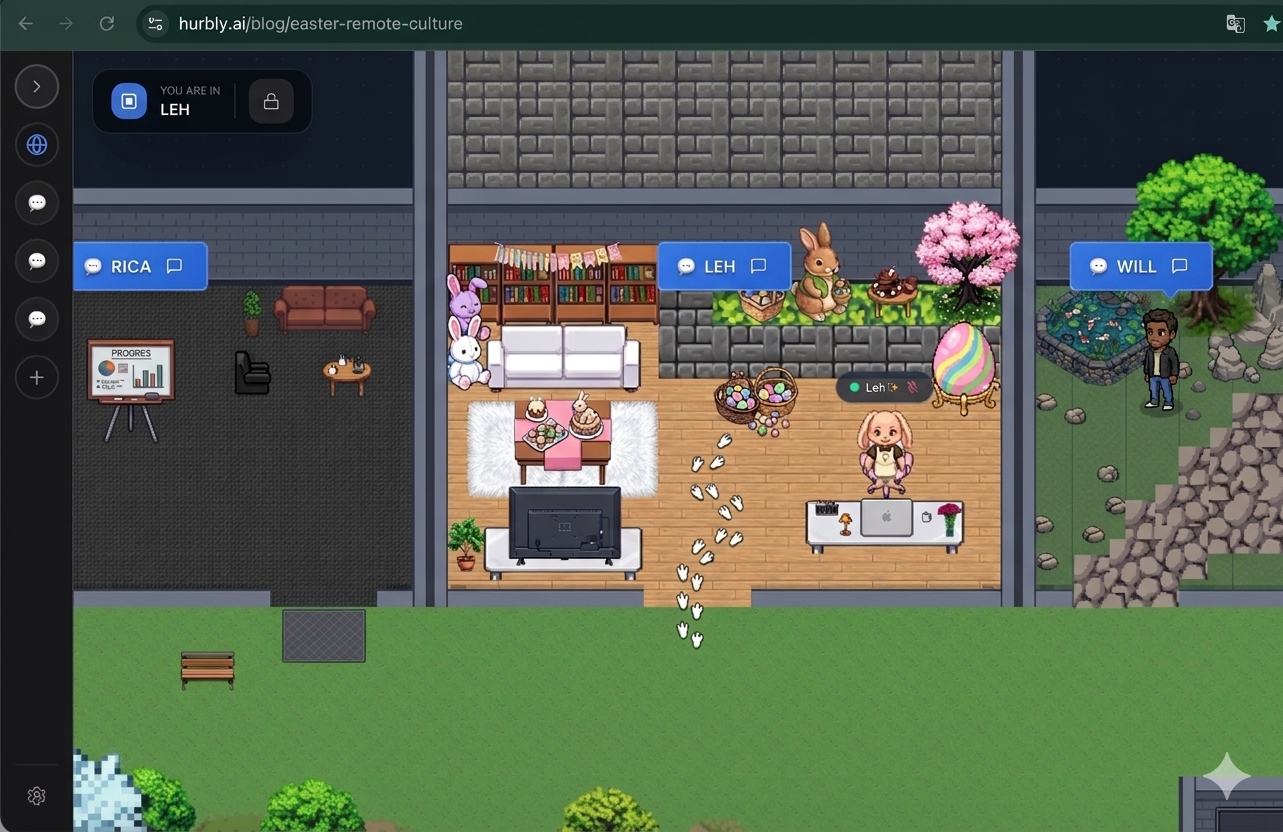
Hurbly gives your remote team a shared virtual space that can actually hold culture. Your team has a place to exist together throughout the day, not just in scheduled meetings, but in all the casual, spontaneous, ambient moments that are the actual building blocks of culture. When someone has a win, they can pop into the team room and share it. When someone wants to grab a virtual coffee, they just show up. When the team finishes a big project, they can celebrate together in the moment.
It's the difference between a team that coexists in a project management tool and a team that genuinely inhabits a shared world. And that difference is enormous for culture.
Try Hurbly free for 30 days and start building something that actually feels like a team.
Frequently Asked Questions
Q: How long does it take to build a strong remote team culture?
A: Realistically, building a culture that people can feel and name takes 6-12 months of consistent effort. You'll see early signals of it working in 30-60 days if you're doing the right things, people engaging in social channels, referencing shared language, bringing energy to team rituals. But culture is always in process; even established cultures need ongoing investment.
Q: Can culture really survive if the team is fully remote and never meets in person?
A: Yes, absolutely, plenty of world-class remote companies have built incredible cultures without regular in-person contact. What matters more than physical location is intentionality, consistency, and genuine care for people as humans. That said, even one or two in-person team retreats per year can significantly accelerate and strengthen remote culture.
Q: How do we keep culture consistent when the team grows quickly?
A: This is one of the hardest parts of remote culture at scale. The key is documentation, writing down your norms, your values in operational terms, and your onboarding practices so new people inherit the culture, not just a job description. Culture carriers (long-tenured employees who embody the culture) are also crucial; involve them in onboarding and give them visible roles in team rituals.
Q: What if our team spans multiple countries and cultures? How do we build a cohesive culture?
A: Multicultural remote teams need to be especially thoughtful about shared values versus imposed cultural norms. Focus on unifying around your company's specific values (transparency, directness, care, etc.) while respecting and celebrating national and cultural differences. Include team members from different backgrounds in defining how the company culture is expressed. And be careful about scheduling norms, what's "normal work hours" isn't universal.
Q: Should culture be top-down (led by leadership) or bottom-up (shaped by the team)?
A: Both. Leadership sets the values, models the behaviors, and creates the structures that make culture possible. The team fills those structures with meaning through their interactions, rituals, and relationships. Cultures that are purely top-down feel imposed and don't stick. Cultures that are purely bottom-up tend to be inconsistent and fragile. The sweet spot is leadership setting the container and the team filling it.
Want your remote team to actually feel connected? Try Hurbly free for 30 days →

