Comparing Top Down vs Bottom Up Management Approaches in Modern Organizations

In this article

Comparing Top Down vs Bottom Up Management Approaches in Modern Organizations
Effective organizational leadership in 2026 requires a deep understanding of how authority and information flow through a company. When evaluating top down vs bottom up management approaches, leaders must decide whether decisions should originate from executive levels or emerge from the frontline employees. The top-down method relies on a centralized hierarchy where senior leaders establish goals, budgets, and strategies, which are then cascaded down to the rest of the organization. This structure provides clear direction and high levels of accountability, making it useful for large-scale operations requiring strict coordination.
In contrast, the bottom-up method focuses on employee participation and decentralized decision-making. In the debate of top down vs bottom up management approaches, the latter is often praised for fostering innovation and increasing employee engagement. By allowing team members to contribute to the strategic direction, companies can leverage the unique insights of those closest to the customers and the daily technical challenges. This approach often leads to higher morale, as staff feel their expertise is valued by the organization.
Key Differences and Operational Mechanics
The fundamental distinction between top down vs bottom up management approaches lies in the point of origin for initiatives. In a top-down system, the "what" and "how" are predefined by leadership. This minimizes role ambiguity and ensures that all departments move in a unified direction. However, this can sometimes lead to a "silo" effect where information takes too long to reach the top, potentially slowing down the response to market changes.
When analyzing top down vs bottom up management approaches, we see that bottom-up systems prioritize feedback loops and collaborative problem-solving. While this can lead to a more agile environment, it may also result in a lack of cohesive vision if not managed correctly. Modern digital tools, such as the virtual office solutions found at hurbly.ai, help bridge these gaps by providing real-time visibility into team activities, regardless of which management style is employed.
| Feature | Top-Down Approach | Bottom-Up Approach |
|---|---|---|
| Decision Making | Centralized at the executive level | Decentralized among team members |
| Communication | Primarily vertical (downward) | Multi-directional and collaborative |
| Primary Strength | Speed of implementation for large goals | High innovation and employee buy-in |
| Primary Risk | Disconnect from frontline realities | Potential for lack of strategic focus |
Strategic Implementation and Workflow Efficiency
Choosing between top down vs bottom up management approaches often depends on the specific project or the maturity of the team. For instance, during a crisis or a major corporate restructuring, a top-down strategy is often necessary to ensure stability and rapid execution. The clarity provided by a single source of truth allows teams to act without hesitation. This efficiency is a hallmark of the traditional corporate structure.
Conversely, for creative projects or software development, the comparison of top down vs bottom up management approaches usually favors the bottom-up style. This encourages developers and designers to experiment and iterate based on their direct experience. To support this fluidity, platforms like hurbly.ai allow distributed teams to maintain a sense of presence, making it easier for bottom-up ideas to be shared spontaneously without the need for formal, scheduled meetings.
Impact on Remote and Distributed Teams
In the current landscape of 2026, remote work has complicated the choice of top down vs bottom up management approaches. Remote teams often struggle with the "visibility gap," where managers cannot easily see the progress of bottom-up initiatives. Top-down directives can feel even more isolating when delivered via email or static documents. Therefore, successful remote companies often adopt a hybrid model that takes the best elements from both philosophies.
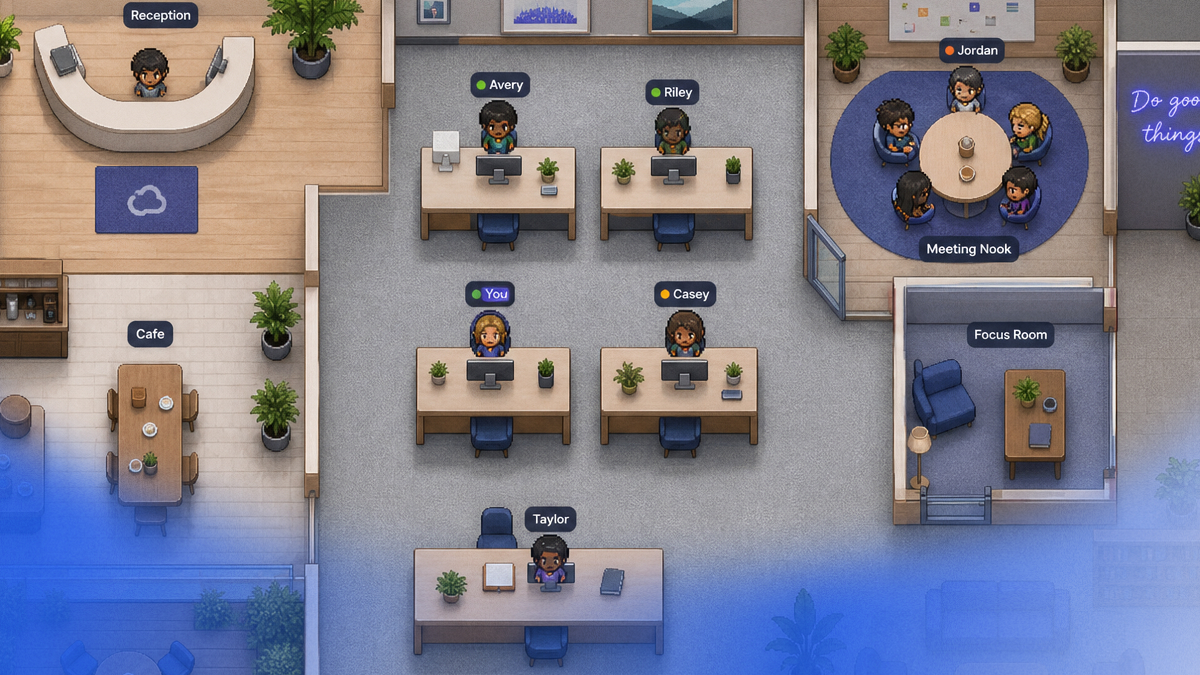
To manage the nuances of top down vs bottom up management approaches in a digital environment, teams require tools that simulate a physical office. By using hurbly.ai, organizations can see who is focused, who is in a meeting, and who is available for a quick chat. This real-time presence data supports top-down oversight while simultaneously enabling the spontaneous, bottom-up interactions that drive modern innovation.
Selecting the Right Model for Your Organization
The decision-making process for top down vs bottom up management approaches should involve an assessment of the company's culture and industry demands. Organizations in highly regulated sectors may lean toward top-down structures to ensure compliance and risk management. Meanwhile, startups and tech firms often find that the flexibility of bottom-up structures allows them to pivot faster in competitive markets.
- Analyze Organizational Goals: Determine if the priority is rapid, uniform execution or creative problem-solving.
- Assess Team Maturity: High-performing, senior teams often thrive under bottom-up management.
- Evaluate Communication Tools: Ensure your infrastructure, like hurbly.ai, supports the chosen flow of information.
- Monitor Feedback: Regularly check if the current balance of top down vs bottom up management approaches is meeting employee and business needs.
Future Trends in Management Philosophy
As we look further into 2026, the rigid divide between top down vs bottom up management approaches is beginning to blur. "Middle-out" management is emerging, where middle managers act as vital translators between executive vision and frontline execution. This evolution acknowledges that neither a purely autocratic nor a purely democratic system is perfectly efficient for every scenario.
The integration of real-time collaboration technology is a major driver in this shift. When comparing top down vs bottom up management approaches, the limiting factor is often how quickly information can be verified and acted upon. By utilizing a virtual office environment like hurbly.ai, leaders can maintain the strategic alignment of a top-down model while fostering the organic, peer-to-peer communication essential for a healthy bottom-up culture. Ultimately, the most successful organizations will be those that can fluidly transition between these top down vs bottom up management approaches based on the specific challenges they face.