27 Virtual Happy Hour Games Your Remote Team Will Actually Want to Play
In this article

If you've ever sat through a virtual happy hour where someone unmuted themselves to say "so... what do we talk about?" and then everyone laughed nervously for thirty seconds before three people said they had to go, you already know the problem.
Virtual happy hours don't fail because people don't want to connect. They fail because there's nothing to do together. The structure that makes in-person gatherings feel natural shared drinks, a bar counter to lean on, background noise that fills the silence doesn't exist on a video call. Without something to anchor the conversation, even the most social teams end up staring at a grid of faces wondering who should talk next.
The solution isn't to force fun. It's to give people something to do together that naturally creates conversation, laughter, and the kind of moments that turn coworkers into colleagues who actually like each other.
Here are 27 virtual happy hour games organized by what you're actually trying to accomplish.
Before You Pick a Game: Three Questions That Matter
How big is your team? Games that work beautifully with eight people become chaotic or boring with twenty-five. I've organized these by size range so you're not setting up a trivia round for forty people who can't all answer at once.
What energy level are you going for? Sometimes you want people laughing out loud. Sometimes you want something low-key that lets conversation happen naturally. Both are valid. I've marked the energy level for each option.
What do you actually want people to feel after this? Connected to each other? Like they learned something fun? Like they just had a genuinely good time? The best happy hour activity is the one that creates the feeling you're going for, not the one with the highest production value.
Games for Small Teams (4-12 people)
1. Two Truths and a Lie (Energy: Low)
Yes, it's old. It works because it scales to any group and naturally generates real conversations. The trick is to require that at least one of the truths be something most people on the call don't know. You'd be surprised how much you don't know about people you work with every day.
2. Jackbox Games (Energy: High)
Quiplash, Fibbage, and Drawful are specifically designed for groups where most people are watching on one screen but they work just as well when everyone has their own device. Players join from their phones, which removes the screen-sharing friction. Start with Quiplash if you're introducing Jackbox to people who haven't played before.
3. Online Escape Room (Energy: High)
Platforms like Breakout Games and The Escape Game offer virtual versions of their rooms. Teams of 4-8 work together to solve puzzles against the clock. It's genuinely collaborative and creates shared memories that people reference months later.
4. Trivia with a Twist (Energy: Medium)
Standard trivia works, but the "twist" is what makes it memorable. Try running a round where all questions are about the company when was it founded, what was the first product shipped, who joined in which month. People who know the answers feel recognized. People who don't learn something real.
5. Show and Tell (Energy: Low)
Give everyone three days' notice to bring one object from their home that represents something they care about. Five minutes per person, then questions. You learn more about your teammates in one of these sessions than in months of weekly standups.
6. Online Pictionary (Energy: High)
Skribbl.io is free and requires no setup. Someone shares their screen and draws while everyone guesses. The category can be work-related (company jargon, product names, internal jokes) or completely random. Both work.
7. Recipe Swap Happy Hour (Energy: Low-Medium)
Everyone makes the same cocktail or mocktail at home from a shared recipe. You discuss the results, what worked, what didn't, and someone inevitably has a better variation. It creates a shared experience even though everyone is in their own kitchen.
8. Virtual Museum Tour (Energy: Low)
Google Arts and Culture has virtual tours of hundreds of museums. Pick one, share your screen, and wander together. Surprisingly good conversation starter for teams that have a lot of intellectually curious people.
9. GeoGuessr (Energy: Medium-High)
One person shares their screen while the group works together to figure out where in the world the Street View image is from. There's a team mode that works well for video calls. People who travel frequently suddenly become very useful teammates.
10. Personality Quiz Debrief (Energy: Low)
Have everyone take the same short quiz before the call Myers-Briggs, Enneagram, 16Personalities and spend the happy hour talking about the results. Works best when the facilitator creates a few discussion questions in advance rather than just letting people read their results.
Games for Medium Teams (12-25 people)
11. Virtual Bingo (Energy: Medium)
Create bingo cards with squares that match things that are true about your team or company. "Has worked here more than three years." "Has a pet on camera right now." "Has met a teammate in person." First to five in a row wins. Free bingo card generators exist for this.
12. Kahoot! Trivia (Energy: High)
Kahoot works well for larger groups because everyone can participate simultaneously. Pre-build the trivia deck or use a template. The real-time leaderboard creates natural competition that keeps energy high even in groups where some people don't know each other well.
13. Werewolf or Among Us (Energy: High)
Social deduction games are ideal for remote teams because they create exactly the kind of interpersonal reading and conversation that video calls usually suppress. Among Us runs on phones and PCs. Werewolf can be facilitated by one person who manages the rounds.
14. Team Bucket List (Energy: Low-Medium)
Everyone submits three things they want to do before they die. A facilitator shares them anonymously and the group tries to match each bucket list item to the right person. The conversation that follows is always better than the game itself.
15. Virtual Cooking or Cocktail Class (Energy: Medium)
Book a session through platforms like Sur La Table or The Gourmand School. A professional instructor guides everyone through making the same dish or drink from their own kitchens. Works particularly well for teams that span multiple time zones and cultures.
16. Company Jeopardy (Energy: High)
Build a Jeopardy board using a Google Slides template (there are dozens of free ones). Categories can include company history, product knowledge, team trivia, and one absurd category that makes no sense. Divide into teams of 3-4 so everyone has a role even in a larger group.
17. Photo Contest (Energy: Medium)
Give a theme a week in advance. "Best sunset you've seen this month." "Most interesting thing in your fridge right now." "Your desk at 3pm today." Share all submissions at the happy hour and vote. No professional photography required the point is the conversation about each photo.
18. Virtual Scavenger Hunt (Energy: High)
Send clues via chat at timed intervals. Items to find can be around the house ("find something older than you") or in a shared digital space ("find the oldest message in our team Slack channel"). First person to post evidence wins each round.
Games for Large Teams (25+ people)
19. Breakout Room Rotations (Energy: Low-Medium)
Divide into random rooms of 4-6. Give each room the same conversation starter or mini-game. Rotate after ten minutes. People meet teammates they might never interact with in normal work. Works best when the facilitator keeps transitions tight.
20. Virtual Talent Show (Energy: High)
Sign-ups in advance, three minutes per act, anything goes. Playing an instrument, doing a magic trick, speed-solving a Rubik's cube, telling terrible jokes. The bar is low on purpose. Low bar = more people willing to participate = better energy in the room.
21. Team Awards Ceremony (Energy: Medium)
Pre-collect nominations for ridiculous categories. "Most likely to still be on the call at midnight." "Best background in a video meeting." "Person who always has the best suggestion five minutes after the meeting ends." Read the nominations and let people vote live. Keep it kind, not roast-style.
22. Guess the Baby Photo (Energy: Low-Medium)
Everyone submits a childhood photo. Share them one by one and have the group guess who it is. Surprisingly competitive and generates genuine warmth. Requires advance coordination but minimal facilitation during the event.
Low-Prep Options for When You Have Less Than a Day
23. This or That (Energy: Low)
One facilitator reads pairs of options. "Coffee or tea?" "Work from home forever or office forever?" "Be always five minutes early or always five minutes late?" Everyone answers simultaneously using thumbs up/down or a reaction. Runs itself with zero setup.
24. Word Association Chain (Energy: Low-Medium)
One person says a word. The next person says the first word that comes to mind. Goes around the circle until someone hesitates or the chain reaches somewhere absurd. Stupidly simple and somehow always funny.
25. Virtual Pub Quiz via Quiz.com (Energy: Medium-High)
Quiz.com has pre-built trivia rounds you can run with no preparation. General knowledge, pop culture, sports. Enough categories to find something everyone can participate in.
26. LinkedIn Profile Roast (Energy: High)
With permission only. Someone shares their own LinkedIn headline or summary, and the group collaboratively rewrites it to be either more honest or more absurdly corporate. Only works in teams where people are comfortable with each other.
27. The Compliment Round (Energy: Low)
Goes last, not first. Everyone writes one genuine compliment about one specific person in the chat. Read them out loud or give people time to read simultaneously. Ends the happy hour on the note that actually matters people feeling seen by the people they work with.
How Hurbly Makes Virtual Happy Hours Feel Less Like Video Calls
The games above work better when your team already has a sense of each other's presence throughout the day. One of the reasons virtual happy hours can feel forced is that the happy hour is the only time remote teams actually see each other so there's too much pressure on one event to carry the whole weight of team connection.
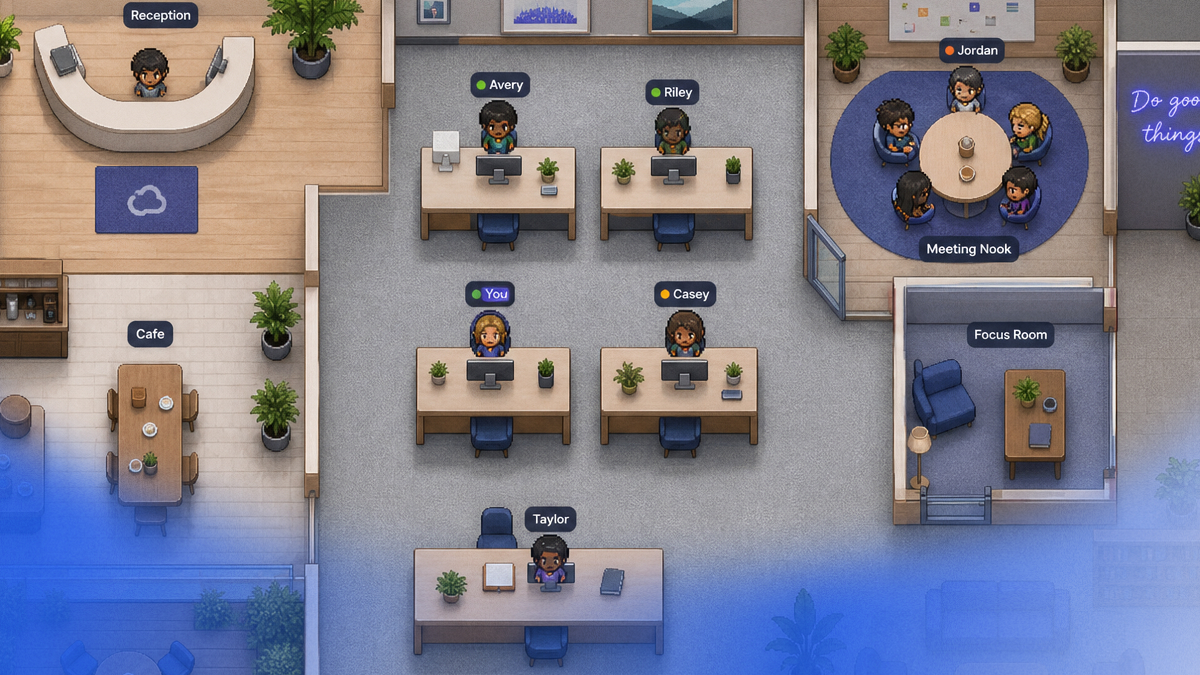
Hurbly gives remote teams a shared space where presence is ambient and continuous. When people can see who's around, drop into a quick conversation without scheduling, and share a virtual space throughout the workday, the happy hour stops being the only connection point and starts being what it should be a fun way to end a week with people you already feel close to.
FAQ
How long should a virtual happy hour be?
Sixty to ninety minutes is the sweet spot. Less than sixty and it feels like you rushed. More than ninety and energy drops regardless of how good the activity is. Build in a natural ending point rather than waiting for people to start dropping off.
What's the best time for a virtual happy hour with global teams?
There's no perfect time when your team spans more than one continent. The fairest approach is to rotate the time so different regions take turns with the inconvenient slot, rather than always scheduling to the convenience of the largest or most senior group.
How do you get people to actually show up?
The activity matters. If people know there's something specific and fun happening not just "we're going to hang out" attendance is higher. Send a clear description of what you'll be doing and why it'll be worth their time.
Do virtual happy hours actually improve team culture?
When they're done well, yes. The research on remote team performance consistently shows that social connection and psychological safety are the strongest predictors of team effectiveness. Virtual happy hours are one of the most accessible ways to build that connection intentionally.
What if some people on my team don't drink?
This should be a non-issue by now, but still worth addressing explicitly. Frame the event as a social hour, not a drinking event. The games listed here all work regardless of what's in anyone's glass.
The best virtual happy hour is the one your team talks about on Monday morning. Start with one game from this list, keep it under ninety minutes, and resist the urge to over-engineer it. The connection comes from the shared experience, not from the production value.
See how Hurbly gives your remote team a space to connect every day, not just at happy hours Try Hurbly free for 30 days →